It Must be the Water: Agroforestry’s Key to Success
Guest Post by Randall Hyman
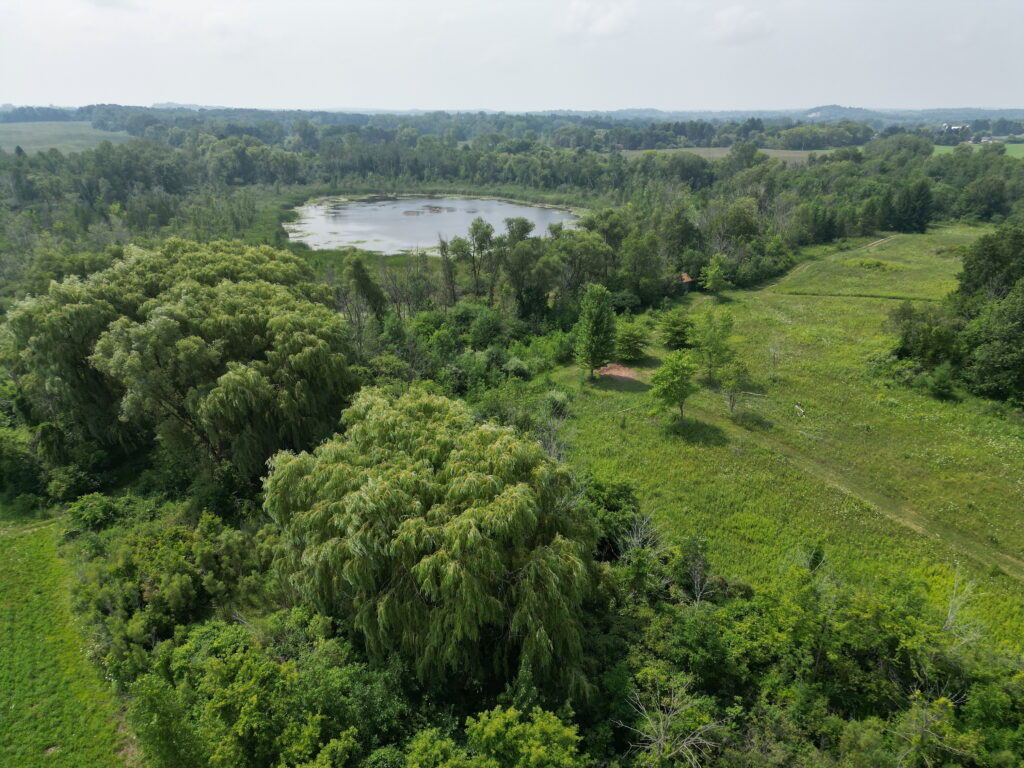
Aerial view of surrounding vegetative buffer protecting Sandhill Lake; Riveredge Nature Center, Saukville, Wisconsin.
A Note from the Fund:
This is a follow-up story first told in 2022 about a team led by the Savanna Institute (with over ten partners) working to transform agriculture in the basin by building the tools, demonstration sites and technical support farmers need to transition from conventional row-crop farming to agroforestry systems. Writer/photographer, Randall Hyman, returned to the very same sites he reported on in 2022 to record what changes had taken place. Read Randall’s article below as he describes how the sites have become unrecognizable in just three years, transitioning from empty corn fields to silvopasture, wooded buffers, and alley cropping systems, proving that trees can transform a landscape, produce food, shelter livestock, improve biodiversity, and provide water quality improvements in a short period of time. We often think of needing to wait many years or even decades before the benefits of trees can be felt, however, this project proves that measurable positive changes can happen much, much sooner!
It Must be the Water
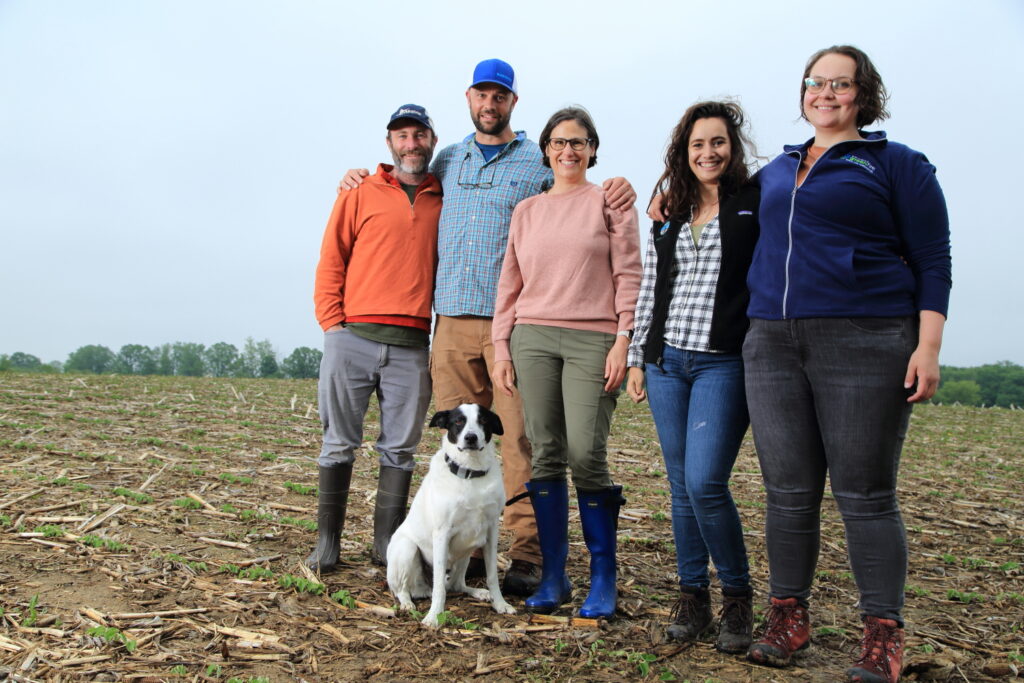
Pushing through waist-high grasses with biologist Matt Smith, I search in vain for the field where he and his team posed for a photo three years earlier. I remember a bare, muddy slope studded with broken corn stalks, but I see nothing like that close by. His team had big plans back then for this farmland adjoining Riveredge Nature Center, 30 miles north of Milwaukee. It was to be a new beginning, acres of native plants augmenting traditional agriculture. Surely the spot is somewhere nearby, I think, perhaps over the next hill.
“So where did we take that picture in 2022?” I ask, scanning the horizon.
“You’re standing on it—we were right here!” Smith laughs. I am stunned. The spot is unrecognizable from my last visit.
In 2022, Riveredge’s Joe Mantoan (Conservation Manager), Matt Smith (Research and Conservation Director), Melissa Moline (neighbor), with Savanna Institute’s Barbara Decre (Community Agroforester), and Devon Brock-Montgomery (Water Quality Program Manager) survey a field slated for agroforestry at Riveredge Nature Center, Saukville, Wisconsin.
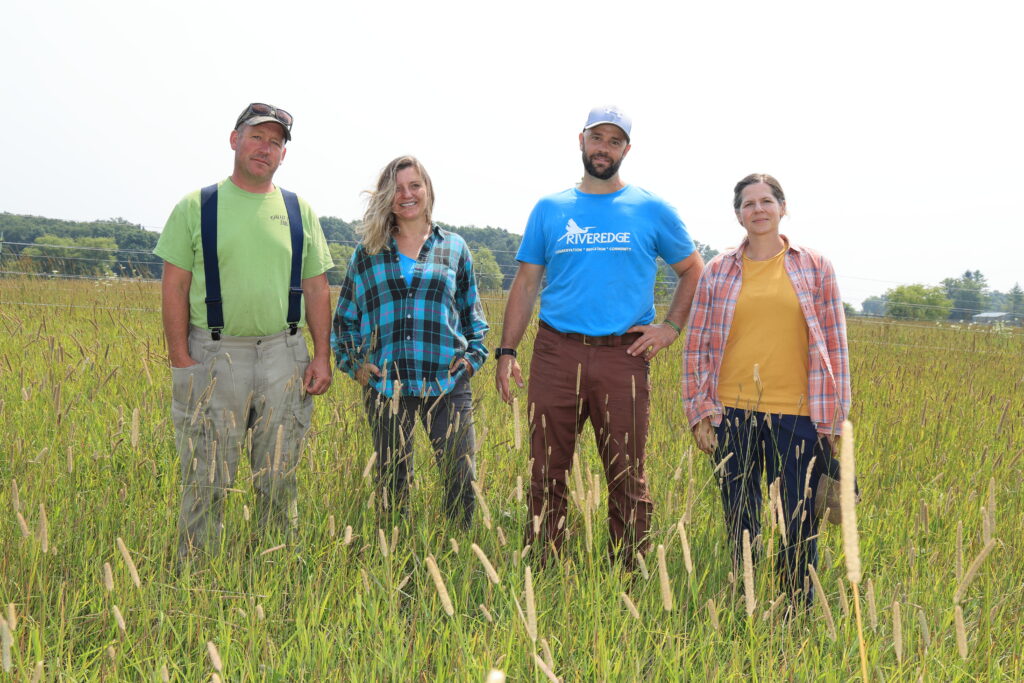
In 2025, Staff photo of Nathaniel Reinartz (Conservation Manager), Jana Gedymin (Research Manager), Matt Smith (Research and Conservation Director), and Kimberly Kisiolek (Conservation Technician) at Riveredge Nature Center, Saukville, Wisconsin.
“These past three years have been a complete vegetation shift,” he explains. “We’ve seeded close to four acres of wet prairie as a buffer along an intermittent stream, and we’ve established cool season perennial grasses throughout most of the silvopasture.”
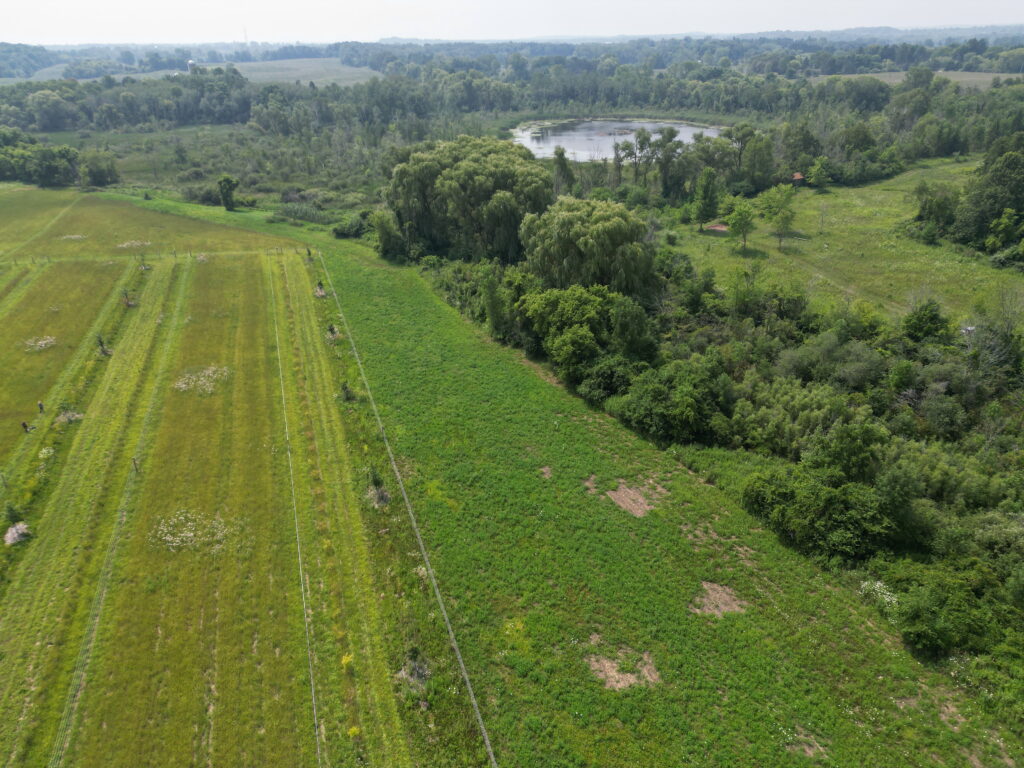
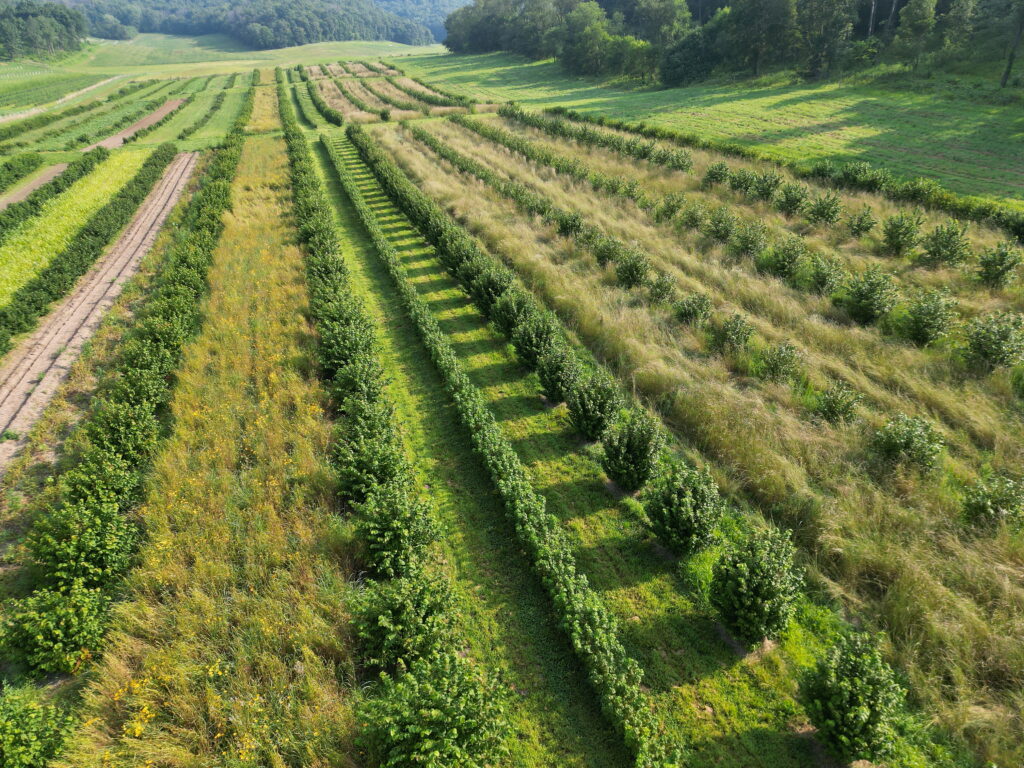
Aerial view of improved farmland featuring silvopasture that incorporates hazelnut, elderberry, heritage apples and prairie; Riveredge Nature Center, Saukville, Wisconsin.
Neat rows of apple saplings line broad avenues of wind-whipped grasses in an arrangement called silvopasture that provides shade for livestock and food for wildlife. A thick band of forest down the hill protects the pristine waters of Sand Lake with what is called riparian forest buffers.
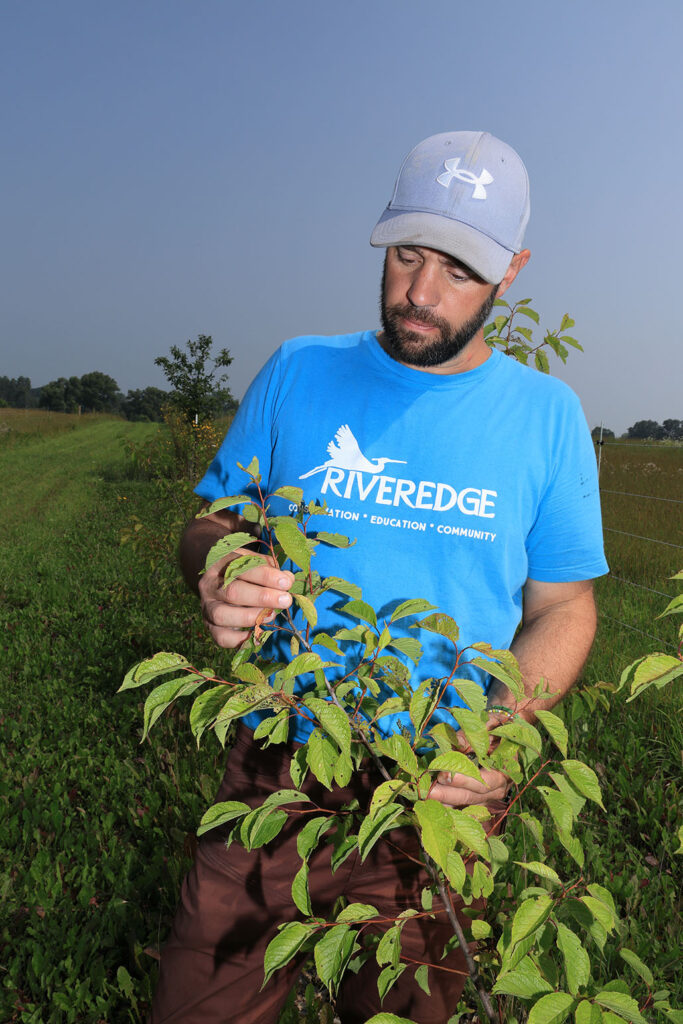
Matt Smith (Research and Conservation Director) examines heritage apple tree in nascent silvopasture at Sandhill Lake Wildlife Reserve; Riveredge Nature Center, Saukville, Wisconsin.
Forest buffers, windbreaks, silvopasture, and alley cropping are all part of a set of agricultural practices called agroforestry researched by the nonprofit Savanna Institute, named for the oak-savanna ecosystems that once dominated much of Wisconsin in a self-sustaining hopscotch quilt of forest and grasslands. In 2021, the Savanna Institute received funding from the Great Lakes Protection Fund to lead a team of over ten partners including Ozaukee Washington Land Trust, Riveredge Nature Center, and the Michigan Agroforestry Partnership to establish a growing set of agroforestry pilot demonstration farms; build a long-term water quality monitoring program to determine the water quality benefits of agroforestry; engage a community of farmers and customers, and develop practitioners’ guides to agroforestry to accelerate its growth across the basin.
The Savanna Institute consulted closely with Riveredge to plan the fields here where 1000 fruiting and nut-bearing woody plants have been installed. This year, Riveredge even logged the first return of breeding savanna sparrows and meadowlarks to this restored pocket of grassland. Smith points out balsam poplar trees that have been planted in the riparian buffer. Balsam poplar is the northernmost deciduous species in North America, whose roots sprout additional trees making it very effective at stabilizing streambanks.
Riveredge is now part of a demonstration site network that partners hope will generate more interest in agroforestry in the region. Nearby, the Ozaukee-Washington Land Trust has added another demonstration site – working with land managers to plant deep-rooted trees, shrubs and plants along the Milwaukee River. The installations of nearly 3000 plants are intended to show the region how to improve municipal water quality by planting forest buffers that capture runoff upstream.
Matt Smith (Research and Conservation Director) and Jana Gedymin (Research Mgr) survey nascent silvopasture and deer-proof electric fence at Sandhill Lake Wildlife Reserve; Riveredge Nature Center, Saukville, Wisconsin.
Erosion-prone cornfield contrasts with dense wooded riparian buffer along Milwaukee River at Riverbend Conservancy in Washington County, Wisconsin.
Ryan Wallin (Restoration & Stewardship Director) and Christine Bohn (Restoration Manager) of Restoring Lands (formerly the Ozaukee-Washington Land Trust) survey nascent prairie and windbreak plantings at Mayhew Preserve; Farmington, Wisconsin.
Taking Root
Working in eight upper Midwest states, the Savanna Institute is cultivating a network of partners, linking farmer with farmer like a root system. New partnerships sprout when stakeholders visit Savanna Institute’s farms, watch online videos, or participate in crowd-sourced problem solving. And by demonstrating how agroforestry enhances soils, improves groundwater, shades livestock, and generates lucrative alternative crops, the Savanna Institute has become a catalyst for change.
Alley cropping on display at experimental North Farm; Savanna Institute, Spring Green, Wisconsin.
Based in Spring Green in Wisconsin’s Driftless Region, the Savanna Institute has grown in recent years from a handful of dedicated personnel to several dozen staff and a network of demonstration farms. With an eye toward what water quality and agroforestry in the Midwest might look like, they designed a commercial-scale, diversified agricultural system at North Farm in Spring Green, which encompasses a complete watershed just North of the Wisconsin Riverway. There was limited research for making the case that agroforestry really improves water quality, and the farm presented the perfect testing grounds.
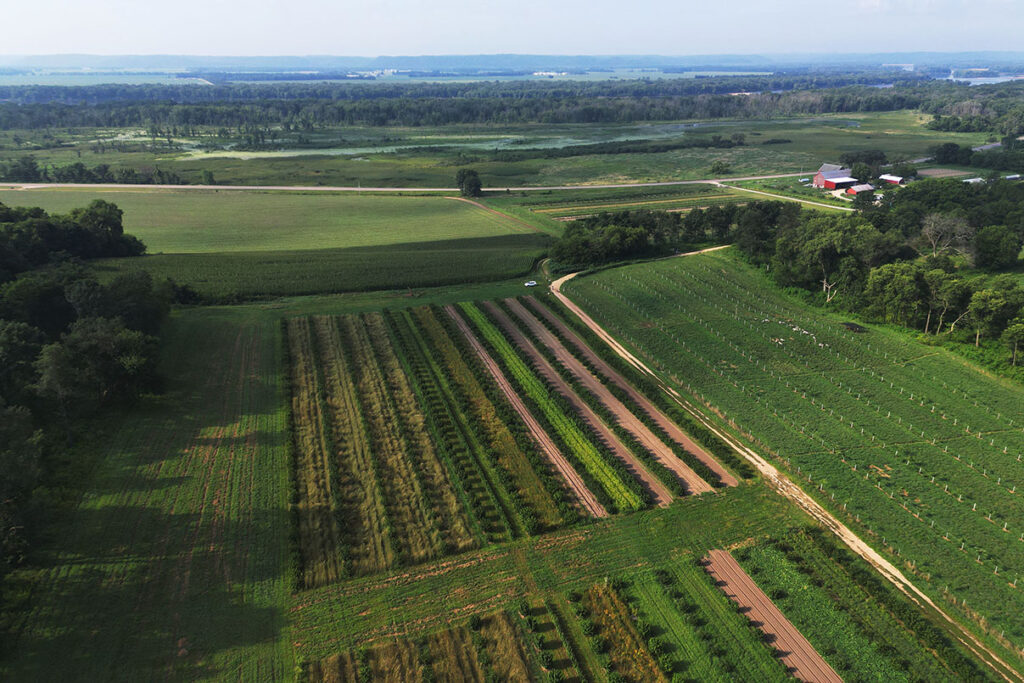
Alley cropping and silvopasture on display at experimental North Farm with Wisconsin River in distance; Savanna Institute, Spring Green, Wisconsin.
Touring North Farm the day after Riveredge, I am dumbfounded by the changes I see. I had been there in 2022 when Savanna Institute staff hand-planted chestnuts, elderberry, hazelnut, and black currants in bare fields, but now the rolling hills are carpeted with silvopasture and lush crops planted in “alleys” between long rows of shrubs and trees.
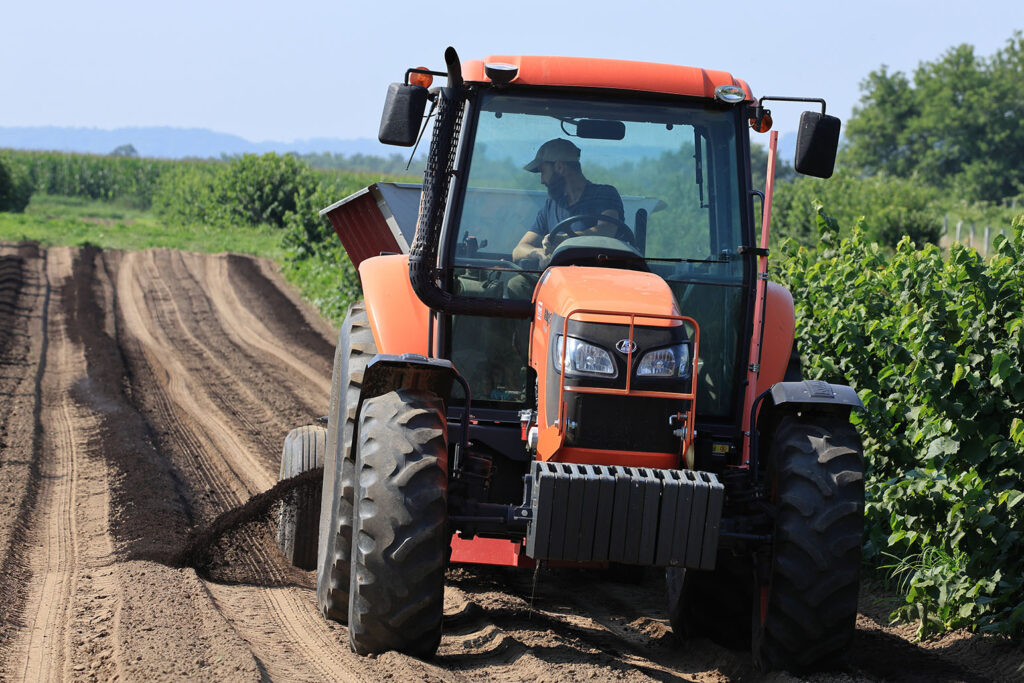
Farm director Erik Hagan drives tractor spreading compost before planting beet crop between hazelnut trees at alley cropping demonstration plot on Savanna Institute's North Farm; Spring Green, Wisconsin.
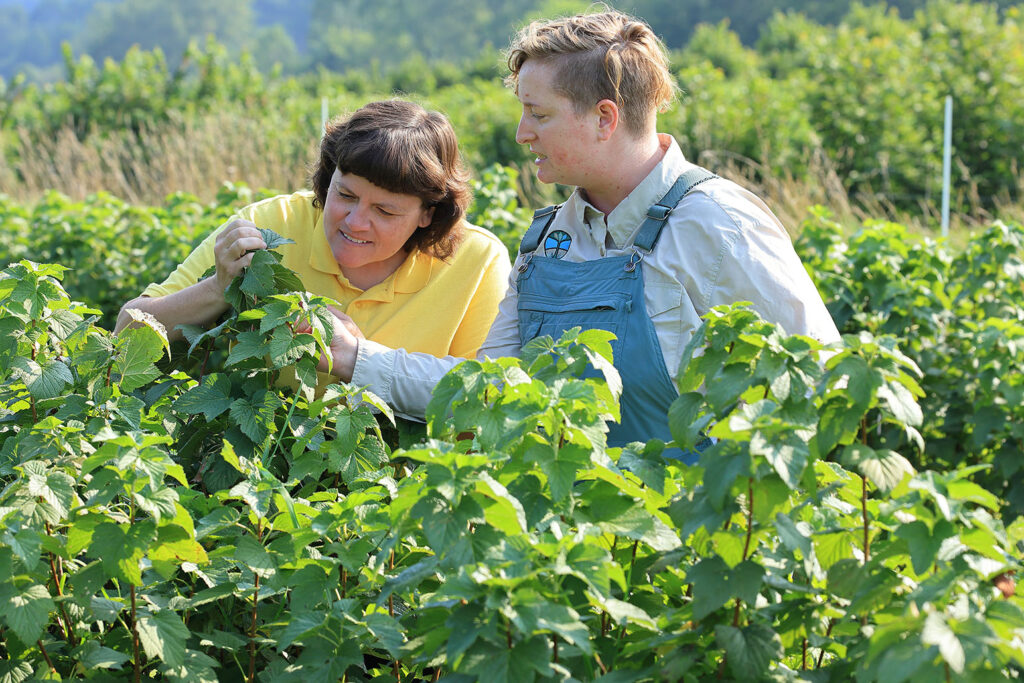
While Savanna Institute Farm Director Erik Hagan spreads compost with a tractor between rows of hazelnuts in preparation for an upcoming beet crop, two Savanna Institute researchers Lily Hislop and Ebony Murrell carefully examine healthy stands of elderflowers and black currants.
Savanna Institute researchers Dr. Lily Hislop and Dr. Ebony Murrell carefully examine healthy stands of elderflowers and black currants; Spring Green, Wisconsin.
Water Proof
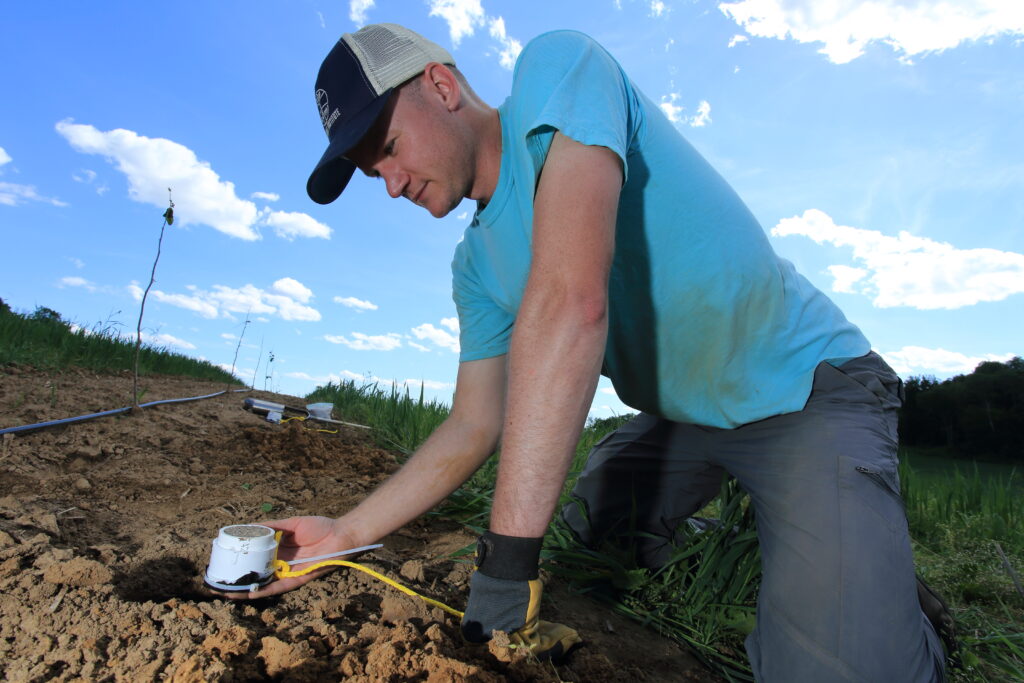
Three years earlier, I had watched Savanna Institute’s Ecosystem Scientist Nate Lawrence diligently bore beneath some of these same hazelnut saplings to install resin lysimeters — small open-top containers packed with sand-like filters for collecting nutrients leaching through the soil beneath each plant. The hope was that careful testing and analysis could determine whether agroforestry truly outperforms traditional agriculture in improving water quality.
Nate Lawrence (ecosystem scientist) inserts resin lysimeter beneath hazelnut saplings for measuring flow of soil nutrients at Savanna Institute's North Farm agroforestry research site; Spring Green, Wisconsin.
After two years of digging, the effort is starting to pay off. Over two hundred lysimeters have been deployed in diverse agroforestry plantings, and adjacent annual cropland. Across all sets of agroforestry-annual comparisons, agroforestry reduced nitrogen leaching –a critical pollutant that threatens drinking water safety and fuels harmful algal blooms across the region. Lawrence is working on the final data analysis, and hopes to have the full project ready for publication later this winter. (To learn more about the water quality monitoring program, watch the video at the end of this story.)
Expanding Partnerships
“A lot of the farmers we talk to come to us first, and they are already excited about agroforestry,” says Eleanor Johnson, Demonstration and Partner Farm Coordinator. “We tend to work with people who are early adopters, but I think there are probably more farmers than people realize who are flying under the radar, implementing practices on their farms that they don’t realize are agroforestry.”
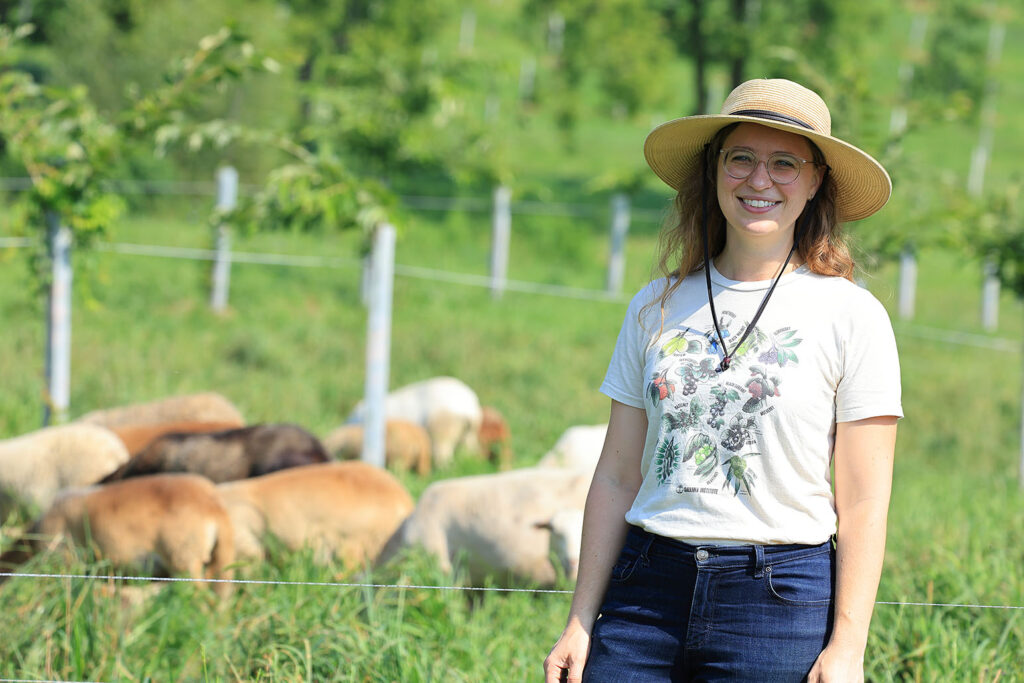
Eleanor Johnson, Demonstration and Partner Farm Coordinator, stands amid sheep in experimental silvopasture at North Farm; Savanna Institute, Spring Green, Wisconsin.
Johnson coordinates one of Savanna Institute’s newest initiatives, the Wisconsin Agroforestry Partner Farm Network, connecting like-minded farmers to give them opportunities to form community through reciprocal farm visits and online sharing. A similar initiative has taken wing in Michigan, led by project partner, the Michigan Agroforestry Partnership. After years of seeding, agroforestry is taking root across the Midwest as farmers teach each other about silvopasture, alley cropping, agrotourism, and a range of other exciting concepts.
“I think agroforestry provides a really sound road map for us to be able to reintegrate our agricultural systems with natural processes, the ecosystems, and the aquifers that supply our farms,” says Nate Ayers, Project Lead for the Michigan Agroforestry Partnership. The group worked with Savanna Institute and Great Lakes Protection Fund to install a demonstration site at Kropscott Farm Environmental Center. The project has grown into a network for farms along the shores of Lake Michigan that are stewarding the ecosystem with trees.
A Vision for Agriculture
At Hillside Pastures in Spring Green, I see more examples of trees planted in pasture, known as silvopasture. Outside the Elderflower Retreat, an agritourism enterprise and event space by the Savanna Institute, cattle graze beside rows of chestnut saplings protected by plastic tubes.
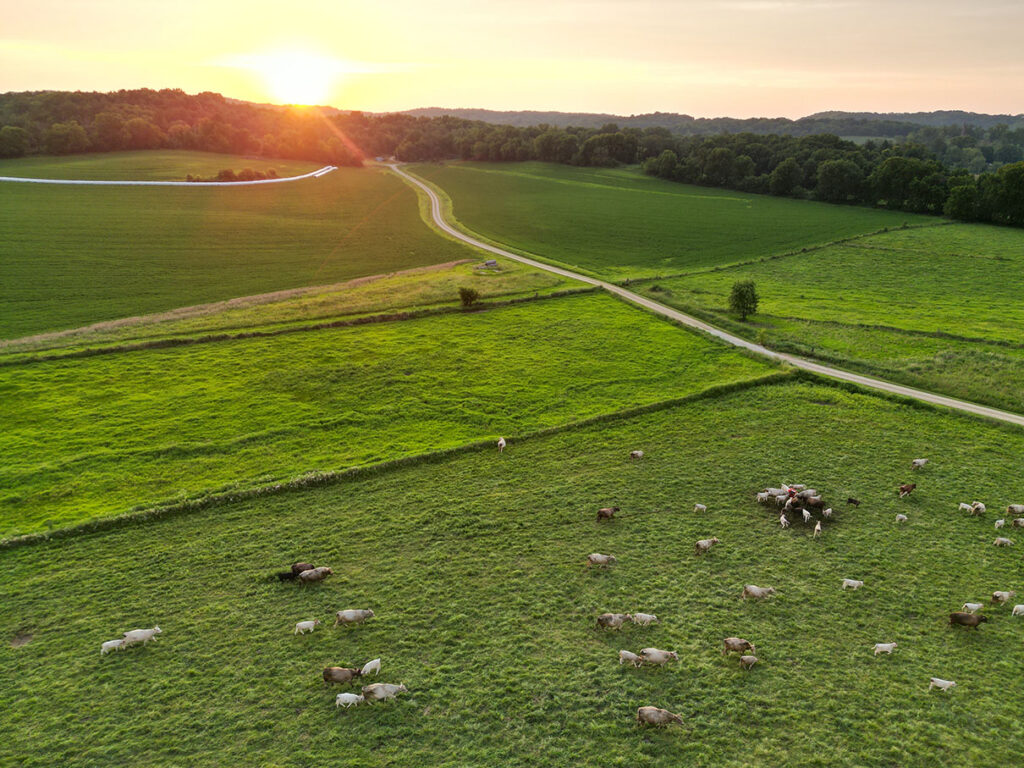
Sun sets behind field where Murray Grey cattle graze at Savanna Institute's Hillside Farm; Spring Green, Wisconsin.
Like much of Savanna Institute’s work, the trees are young but growing fast. In a few more years, this will be a spreading grove of young trees, not unlike the oak-savanna ecosystems that once dominated the region.
A mature silvopasture at Hillside Pastures, a Savanna Institute demonstration farm; Spring Green, Wisconsin.
In the distance, I spy Taliesin, once the cradle of a revolution in architecture led by Frank Lloyd Wright. Savanna Institute’s demonstration farms in Spring Green share more than geography with Taliesin — they share philosophy. Wright believed in fitting architecture into existing landscapes, and the Savanna Institute uses agroforestry to meld agriculture with existing ecosystems.
Why, I wonder, have two revolutions found sustenance in southwestern Wisconsin’s Driftless Area, a region dominated by rivers and streams carving dramatic ridges and valleys in the land’s unglaciated “drift-free” soils? Perhaps it is the water.